Every good mercenary crew needs a way to traverse the solar system—whether it’s traveling to their next contract, resupplying, or simply finding a place to rest during downtime. But moving a crew isn’t just about transporting five people and cargo; it’s about hauling their most valuable assets: battlesuits and all their support equipment. Without their machines, even the most skilled pilots are just augmented humans with nowhere to go.
Ships of the Mercenary Crews
Most mercenary teams operate Terran-made corvettes or cruiser-class ships, designed for long-range travel and efficient transport of battlesuits. These vessels prioritize logistics over firepower, focusing on mobility and sustainability rather than direct combat. Solo mercs and smaller operations may use auxiliary ships—fighter-class vessels retrofitted with cargo hooks to carry their battlesuits externally, sacrificing some security for flexibility.
All ships in the modern era are equipped with hyperdrives, allowing for rapid travel between celestial bodies. However, faster-than-light travel remains a scientific dream, one that hinges on the completion of the Dyson Sphere. Until then, hyperdrives and hyperboost propulsion systems remain the only way to cover vast distances within the solar system.
To sustain these journeys, ships deploy solar arrays and sails, which unfold once in orbit to collect energy. As a failsafe, all ships carry emergency spice gas reserves, which can be burned to generate high-octane energy in case of power failure. Larger ships, such as cruisers and space stations, have built-in power array receivers, drawing low-level energy remotely from the Dyson Sphere’s expanding power network—a system of substations stretching from the inner planets out to the asteroid belt.
The Power Network: Life or Death in Space
The Dyson Sphere’s power grid is still under construction, but its influence is already undeniable. A network of substations and relay nodes spreads from the Sun, through planetary outposts, and out to the edges of No Man’s Land. This infrastructure is crucial for energy distribution—without it, colonies, ships, and battlesuits would be left adrift.
For ships equipped with the necessary energy receivers, power can be remotely drawn from these substations. However, beyond the asteroid belt, power access is unpredictable, requiring crews to carefully manage their reserves. Without energy, a ship is nothing more than a drifting coffin. That’s why, despite the brutal nature of mercenary work, there remains one unspoken rule in space: Always answer a distress call. Even the most ruthless mercenary or corporate fleet will respond to a ship in distress, because no one knows when they’ll be the next ones stranded in the abyss, with only the passing shadows of the Iron Horizon for company.
The Role of the Battlesuit & Its Crew
While mercenary ships lack heavy armament, they carry the most powerful weapons known to modern humanity—battlesuits. These machines of war possess enough destructive capability to flatten entire cities, making them far deadlier than any ship-to-ship combat system. However, battlesuits are not designed for extended space travel. They can operate in low-gravity environments, traverse asteroid fields, and travel short distances between clusters of planetary bodies, but they lack the energy storage to sustain prolonged deep-space engagements.
This is why mercenary crews function as tightly run operations, with every crew member playing a critical role. The popular image of a battlesuit pilot as a lone hero ignores the reality of space warfare—without their technician, engineer, and captain, a pilot is nothing. The battlesuit must be meticulously maintained, fueled, and armed before deployment. The crew’s ship is their lifeline, ensuring that every sortie into battle is both prepared and supported.
Inside the Mech Bay
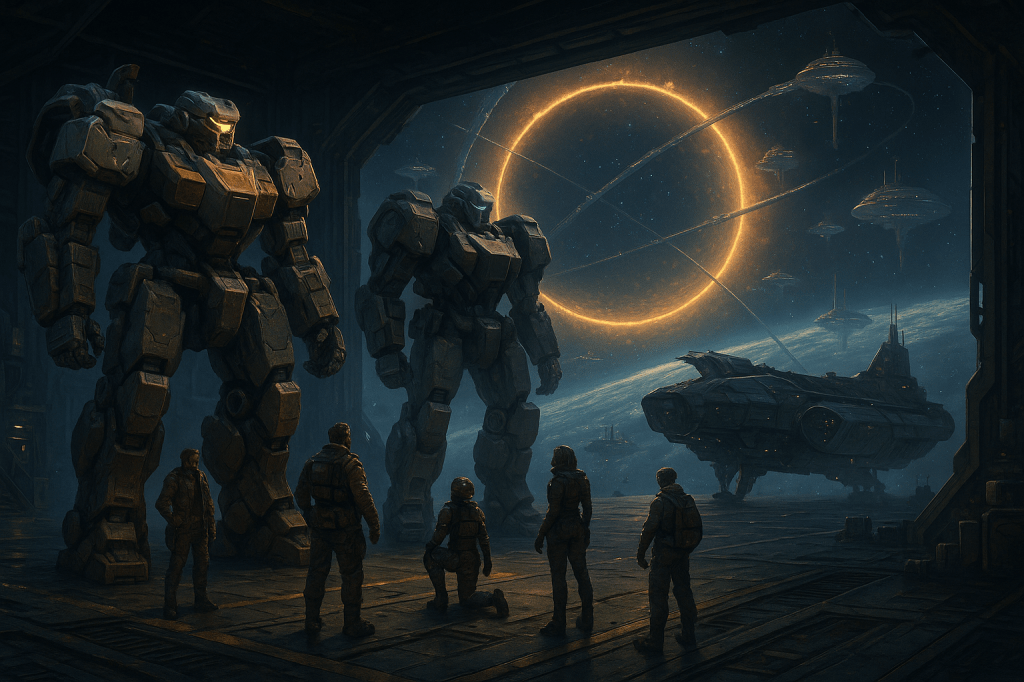
Within every cruiser-class mercenary ship lies a battlesuit mech bay, the beating heart of any crew’s operations. Here, technicians and engineers work around the clock to keep battlesuits in peak condition.
- Cranes and exosuits assist with maintenance, allowing crew members to fit heavy components and weapon systems.
- Simulators inside the cockpit let pilots run tactical scenarios, keeping their reflexes sharp between missions.
- Pre-deployment checks are a standard ritual—just like the fighter pilots of old, battlesuit pilots personally oversee their machines before every mission, ensuring that every system is primed for combat.
A well-maintained battlesuit is the difference between life and death, and most pilots work closely with their engineers to fine-tune their machines. Many crews even customize their battlesuits and ships, painting them with unit insignias, war markings, or personal emblems to show off their combat record. Wealthier crews proudly display sponsor logos, making their allegiance clear, while struggling mercenaries scavenge for second-hand parts to keep their machines operational.
The Lifeblood of Mercenary Warfare
No two mercenary crews are alike—some are corporate-funded elites, others are rogue independents scraping by on meager contracts. But whether they are highly trained professionals or desperate survivors, they all share a common truth: the ship is their home, their battlesuit is their weapon, and their next contract is their future. In a universe where power is everything, and energy is the difference between survival and oblivion, mercenaries walk a fine line between fortune and ruin.
Drifting through space, waiting for their next mission, they live by a simple creed: Keep your ship running. Keep your battlesuit ready. And never, ever run out of power.

 Iron Horizon: Mercenaries